And when did you last have a coffee with them?
At this year’s Design Leadership Retreat, we did a very simple exercise: a classic stakeholder matrix. I thought this method was widely known, but many participants had never done it, and it led to an interesting reflection.
Place your stakeholders on the matrix: How much influence do they have, and how interested are they in the outcomes of design? On its own, this is a mapping exercise. It gives you clarity and helps you externalize what you already know.
It becomes interesting when you compare the relationship you should have with each group to the one you actually have.
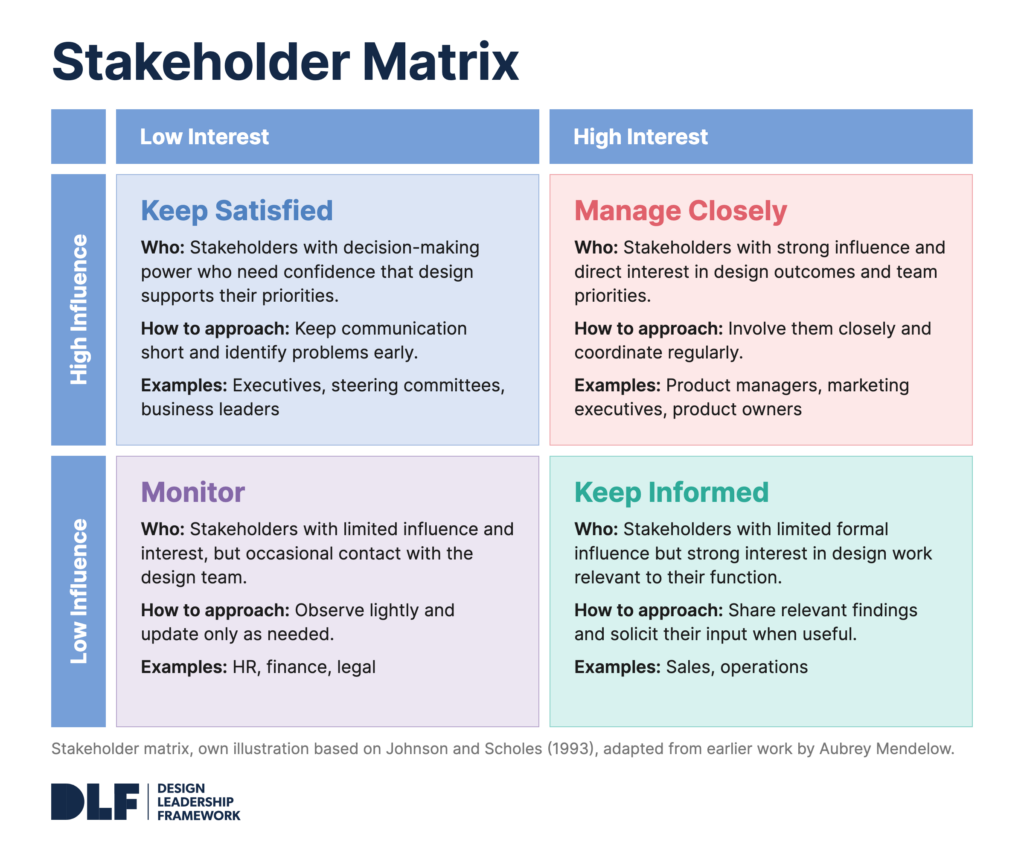
Analyse the current relationships
Do you engage regularly with the stakeholders in the top right quadrant? Do you involve them in decisions, update them frequently, solve problems together, and build a genuine relationship? Do you give concise updates to the stakeholders with high influence but little interest, to keep them satisfied? How do you work with the people in the other quadrants? And how well do you know each stakeholder’s goals?
When we did the exercise, the picture was consistent for some participants: the most influential stakeholders got the most attention. For others, it was the opposite. The relationships with less important groups were much better maintained than those with the groups that matter most. This sparked discussions about how to involve key stakeholders better, where to work together informally, and how to create more regular interaction.
Try it yourself
Take 15 minutes:
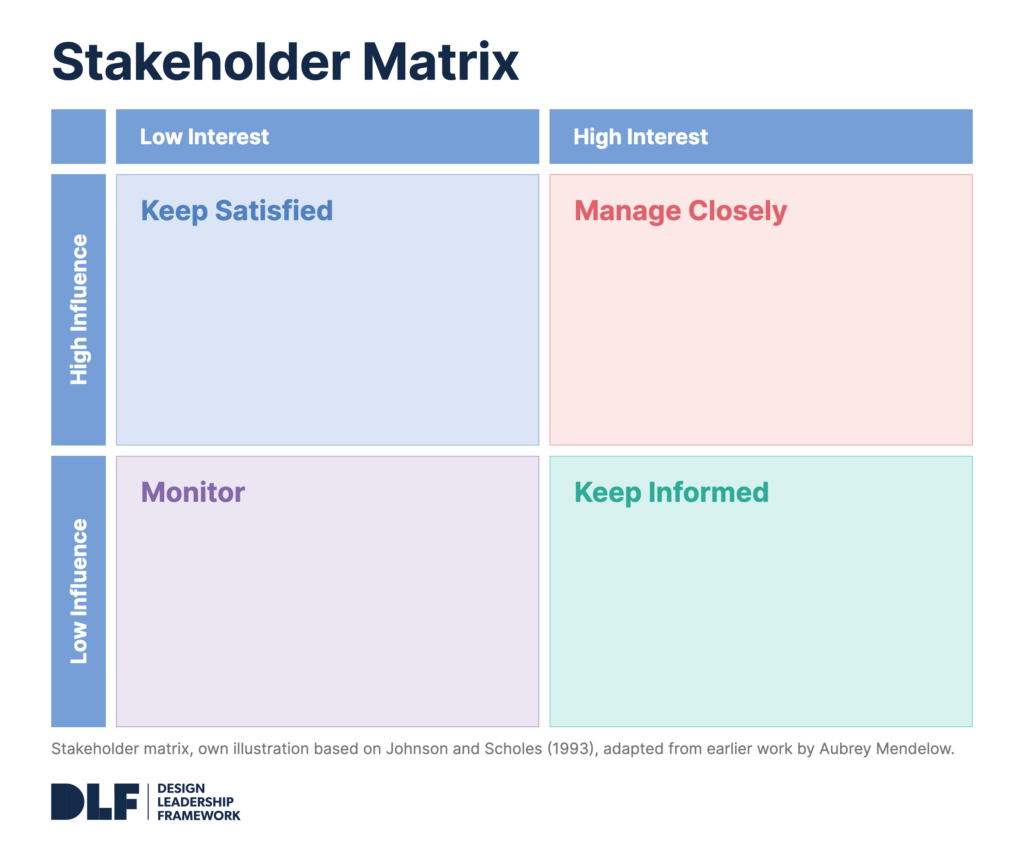
- Use the blank template below, or divide an A4 sheet into four quadrants and label the axes: influence (high/low) and interest (low/high).
- Write each of your stakeholders into the quadrant where you think they fit best.
- For each stakeholder, reflect on how often you talk, in what formats, and whether that matches their position on the map.
- Look especially for mismatches. Who is in “Keep Satisfied” or “Manage Closely” but gets little of your time?
What to do with the result
Once you see the mismatches, the next question is what to change. Here are a few ideas how you could approach it.
1. Pick two or three stakeholders to improve your relationships with
Start with the people in “Manage Closely” and “Keep Satisfied” who currently get the least of your attention.
2. Find out what they care about.
As designers we are usually so good at finding empathy for our users, but don’t do the same when it comes to our stakeholders or our boss. One exercise that can help with that is to write a short profile for a few of your key stakeholders.
- What are their responsibilities and goals?
- What is on their plate right now, and how full is their calendar?
- Who do they answer to, and what do those people expect from them?
- What are they interested in?
In my seminars, this exercise has led to real aha moments. Fore example, for the first time, a product manager was seen as a whole person with a demanding role, not as the person who makes annoying decisions.
3. Learn more about their goals
Invite them for a coffee or lunch and simply try to better understand where they are coming from.
- What topics interest you most currently?
- What are you measured on this year?
- What worries you most about the next few months?
- What would make design’s work more useful for you?
If a one-on-one is not realistic yet, use other occasions first: talk to them at a company event, join a group lunch or use the time before or after a shared meeting to build a bit of connection. Genuine interest in their world tends to create genuine interest in yours.
4. Connect your work to their goals.
Imagine a design manager who wants to be involved earlier in product decisions. If she argues from her own goal (“we want to be heard sooner”), the program manager mostly hears extra work for himself. If she shows how early involvement serves his goals, for example fewer late changes, saved development time, and a better chance at product success, it becomes a different conversation.
Adjust your language and level of detail, too. A steering committee needs a short summary and the business consequence, a product owner needs to know what changes in the next sprint. The more you think of the different groups of stakeholders and what matters to them, the better you can tailor your communication to different situations and needs.
Of course in the beginning this requires a shift in perspective and practicing your communication.
5. Find the right formats and rhythms.
Good relationships need regular contact, and regular contact needs formats. Choose what fits the person and the quadrant, and keep the effort low enough that you will actually do it. Also, different formats work better for different personality types. Some people thrive facilitating workshops for stakeholder groups, creating momentum and aligning people around shared goals. For others, a more personal one-on-one setting works much better to build connection. Often you need a mix of both. Some ideas include:
- A weekly jour fixe: A fixed slot to discuss current topics and obstacles
- Shared working sessions: Scheduled time to really discuss a topic in detail, generate ideas and possible ways forward. I once heard a saying that I like: watch your friendships grow when you solve problems together. It applies to working relationships, too.
- A regular coffee or lunch: Not for business, but to get to know each other as people.
- A regular update format: In a shared meeting or through another channel, where you actually have your stakeholders attention. Keep it short and engaging and easy to digest (e.g. a one pager summary of last month’s achievements), but not too polished so it takes you hours.
- Invitations into your world: Invite stakeholders to a user research session, a design critique, or a demo. Seeing real users struggle or succeed explains more than any slide. Being an active part of a design exploration or review can support understanding of design’s work.
- A look into their world: Is there a meeting or event you can join to better understand their work?
6. Look again in three months.
What did you achieve with your efforts? Did any relationships improve? What were the consequences of it?
The matrix does not say that some stakeholders are less important than others. It gives you hints for finding the formats and rhythms that fit each group best.
For your own work, improving two or three relationships that currently get too little of your attention is usually a good start. Pick one person from the top right quadrant, write down what you know about their goals, and book a coffee this week.
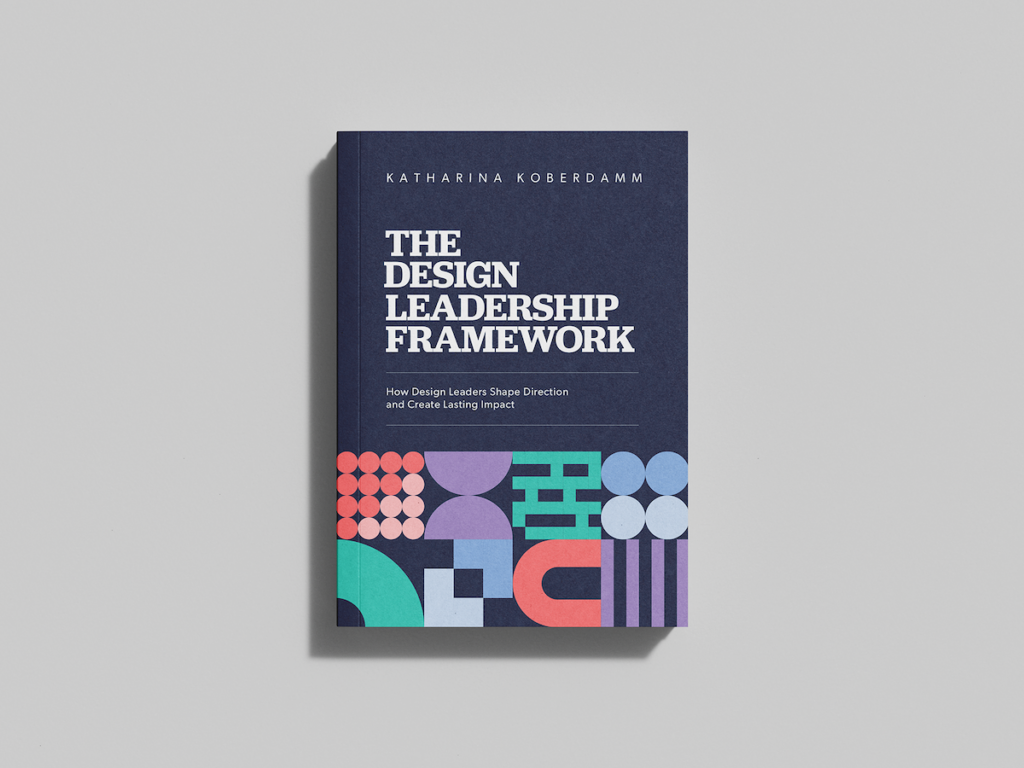
The Design Leadership Framework, my book on how design leaders shape direction and create lasting impact, comes out this November.
It also covers stakeholder relationships and cross-functional collaboration in more depth. Learn more about the book.
Sources
- Stakeholder matrix based on Johnson and Scholes (1993), adapted from earlier work by Aubrey Mendelow. Johnson, G. and Scholes, K. (1993) Exploring Corporate Strategy. Prentice Hall.
- Greever, T. (2020) Articulating Design Decisions. O’Reilly.
- Merholz, P. (2023) UX/Design Leaders: Understand the Motivation of Your Peers and Stakeholders the Same Way You Do Your Users and Customers. https://www.petermerholz.com/blog/ux-design-leaders-understand-the-motivation-of-your-peers-and-stakeholders-the-same-way-you-do-your-users-and-customers/
- Berkun, S. and Zug, B. (2024) Why Design Is Hard. Berkun Media.

Hi, I’m Katharina Koberdamm, Design Consultant and Coach. I created the Design Leadership Framework to empower design leaders to become more strategic, build a strong design function, and drive impactful change. In this blog I share my thoughts and insights from my research and coaching practice. You can find me on LinkedIn.